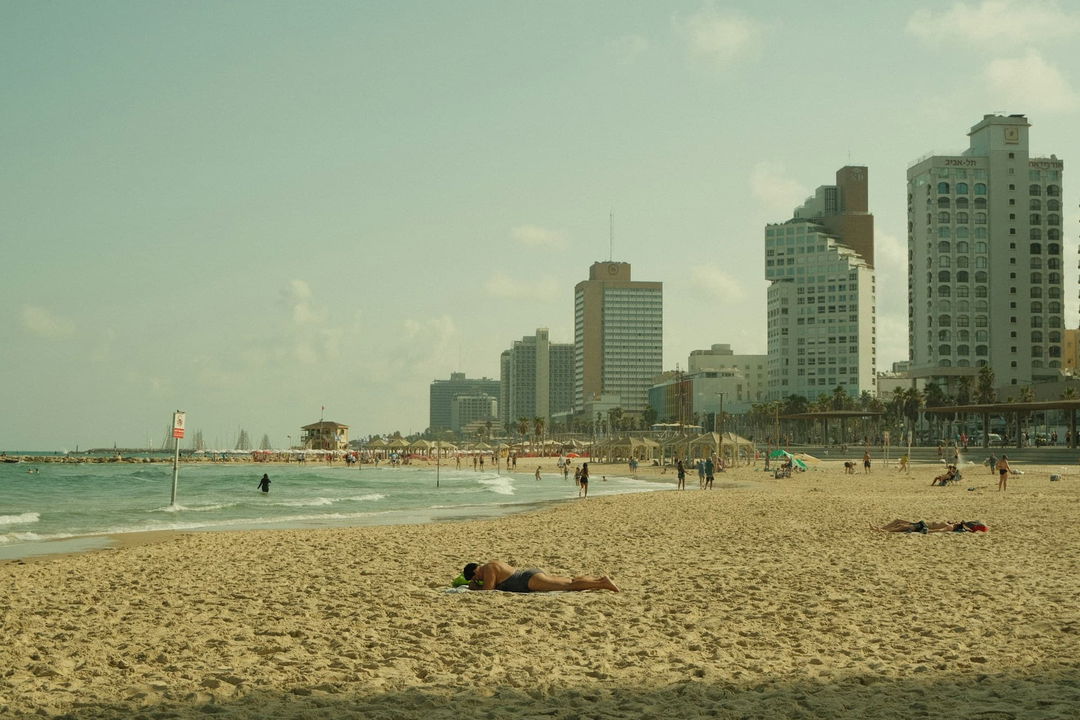
Israel Beach Holidays
Mediterranean beaches at Tel Aviv, Red Sea snorkelling in Eilat, and Dead Sea shores. Plan your Israel beach holiday with flights and travel tips.
€1 = ₪3.50
Today
—
Travel warning
Weather in Israel
Fri
Sat
Sun
SPF level in Israel
Autumn
SPF 50
Spring
SPF 50
Summer
SPF 50+
Winter
SPF 30
Entry requirements for Israel
You can visit Israel without a visa as a tourist and get permission to stay for up to 3 months on entry.
Your passport must have an expiry date at least 90 days after the date you arrive in Israel or Palestine.
As of 1 January 2025, you will need to get an Electronic Travel Authorisation before you arrive, which is valid for 2 years and covers a 90-day visit.
Keep the entry card you receive at border control with your passport until you leave as evidence of legal entry.
You may face lengthy personal questioning and baggage searches, and security may request access to personal email or social media accounts.
Good to know:
If crossing from Israel into Egypt at Taba, bring sufficient US dollars in cash as fees are charged and ATMs are unreliable.
Children aged 17 and under travelling alone or with one parent should carry a letter from parents or guardians confirming consent and accommodation plans.
Safety in Israel
Israel is tourist-friendly but has some key cultural and legal rules:
Always carry a copy of your passport ID and entry stamp pages with you as ID is required.
Cover your shoulders, upper arms and legs above the knee in Jerusalem, the West Bank and Gaza.
Be sensitive about taking photos of people in Muslim and Orthodox Jewish areas, and never photograph military or police installations.
Avoid driving into ultra-Orthodox Jewish areas of Jerusalem from Friday sunset to Saturday nightfall as your car may be stoned.
Be extremely cautious if visiting Palestinian refugee camps, as they can be sites of violent clashes.
Bonus tips:
Keep belongings like passports and credit cards secure on public beaches as theft is common.
If planning to drive into the West Bank, check your hire car insurance covers you there, as many do not.
Saily eSIM for Israel
Skip roaming fees with Saily, our partner eSIM provider. Use code ATOBEACH for 10% off. Plans start at €3.15 for 1GB, valid for 7 days.
Activates when you land
200+ destinations
Code ATOBEACH at checkout
Driving in Israel
A UK driving license is valid for driving in Israel for up to one year.
Side of the road
Right
Motorway speed limit
110 km/h
Urban speed limit
50 km/h
Alcohol limit
0.05%
Remember: Israel drives on the right. Take extra care at junctions if you normally drive on the left.
Health in Israel
It's crucial to have comprehensive travel insurance that covers medical expenses, including emergency treatment and repatriation. Check that your policy covers all activities you plan to participate in. While Israel is not part of the EU, it's still advisable to carry your Global Health Insurance Card (GHIC) or European Health Insurance Card (EHIC) as it may be useful in some situations, though it's not a substitute for travel insurance.
No vaccinations required
Consult your doctor or travel clinic for the latest health advice and recommended vaccinations for Israel. Ensure you are up-to-date on routine vaccinations. Mosquitoes can be present, so consider using insect repellent. Drink bottled water to avoid stomach upsets.
Cards & payments
Credit and debit cards are widely accepted in Israel, especially in larger establishments and tourist areas. However, it is always a good idea to carry some cash, particularly for smaller shops, markets, and transportation.
Visa
High
Mastercard
High
American Express
Medium
Lost card? Call Visa: +1-303-967-1096
Tipping in Israel
Tipping is customary in Israel for good service. While often expected, it is always appreciated.
Restaurant
10-15% of the bill
Bar/Café
10-15% of the bill
Taxi
Rounding up the fare or 10% for good service
Hotel Porter
5-10 ILS per bag
Hotel Housekeeper
5-10 ILS per day
Tour Guide
20-50 ILS per person, depending on the length and quality of the tour
Mobile & roaming
Since Brexit, EU roaming agreements no longer apply. Check with your mobile provider for roaming charges in Israel. Roaming charges can be high, so consider purchasing a local SIM card for more affordable data and calls.
Local SIM
20GB for 100 ILS (~£20)
Network coverage
4G, 5G
Electrical in Israel
Voltage
230V / 50Hz
Plug types
Type C, Type H
UK adapter needed
WiFi & internet
WiFi is widely available in hotels, cafes, restaurants, and public areas in cities and tourist locations.
Average speed
50 Mbps
Free WiFi is common, but the quality can vary. Consider using a VPN for security, especially on public networks.
Emergency numbers
Universal emergency
112
Police
100
Ambulance
101
Fire
102
Save 112 in your phone before travelling.
Calling Israel
Country code
972
To call Israel from the UK, dial 00 972 followed by the local number.
UK Embassy
Yigal Alon Tower, 23rd Floor, 67 Yigal Alon Street, Tel Aviv 6744326, Israel
Phone
+972 (3) 725 1222
Website
Ben Gurion Airport
Eilat-Ramon Airport
Haifa Airport
Beer Sheba Airport
Ein Yahav Airport
I.Bar-Yehuda
Recent updates
Safety
Since 8 July, there have been strikes and retaliatory attacks by Iran in a number of locations across the region against US military and civilian infrastructure.
There is a risk of more attacks and unforeseen escalation in the region. The Iranian regime had stated its intention to target locations associated with the US and Israel.
Do not approach or touch any drone or missile fragments or unusual objects if advised to take shelter.
The phrase 'we recommend against all travel to some parts of Israel and Palestine' no longer appears.
The section 'If you are in Israel and Palestine' no longer mentions the frequency of missile and drone attacks having decreased.
No other changes to the specific risk warnings, advice against travel areas, or insurance guidance.
The US and Iran have announced a memorandum of understanding in relation to the Middle East conflict.
Should hostilities resume, travellers should now stay away from areas around security or military facilities and keep their departure plans under review.
There have been recent missile launches towards Israel and Israel has carried out strikes against targets in Iran.
Iranian strikes targeting civilian infrastructure are now described as having previously occurred, rather than the risk just having decreased.
The risk of falling debris from intercepted missiles is explicitly mentioned for parts of the West Bank.
A ceasefire with Lebanese Hizballah resumed after a 60-day implementation period ending in 2026 has now been added.
A new ceasefire on the Israel-Lebanon border was agreed on 16 April 2026.
Status with Lebanese Hizballah changed: a cessation of hostilities was announced on 16 April 2026, but fighting continues.
A new conflict section for Iran added: a ceasefire with Iran was agreed on 8 April 2026, but risk of renewed hostilities remains.
FCDO no longer advises against *all* travel to Israel and Palestine. It now advises against travel only to specific high-risk regions.
Travel is now advised against within 500m of the Gaza border, in parts of northern Israel and the occupied Golan Heights, and in the Tulkarm, Jenin, and Tubas governorates in the West Bank.
The rest of the West Bank (except specified safe areas) is now advised against for all but essential travel, not all travel.
Detailed practical guidance for leaving Israel and crossing into Egypt at Taba (including cash requirements, border taxes, and unreliable ATMs) has been removed from this section.
The list of airlines operating a limited schedule at Ben Gurion Airport and the dedicated assistance form for British nationals have also been removed.
Beaches in Israel
No beaches listed for Israel yet.
Frequently asked Questions
While we strive to provide accurate and up-to-date information, AtoBeach cannot be held responsible for any inaccuracies. We recommend verifying details with official sources before travelling.